Case Law
The Shift in Apportionment: Analyzing the Recent En Banc Decisions
The landscape of apportionment in California workers' compensation law is undergoing a subtle but significant transformation.

Chris Lyle
Co-Founder & CEO
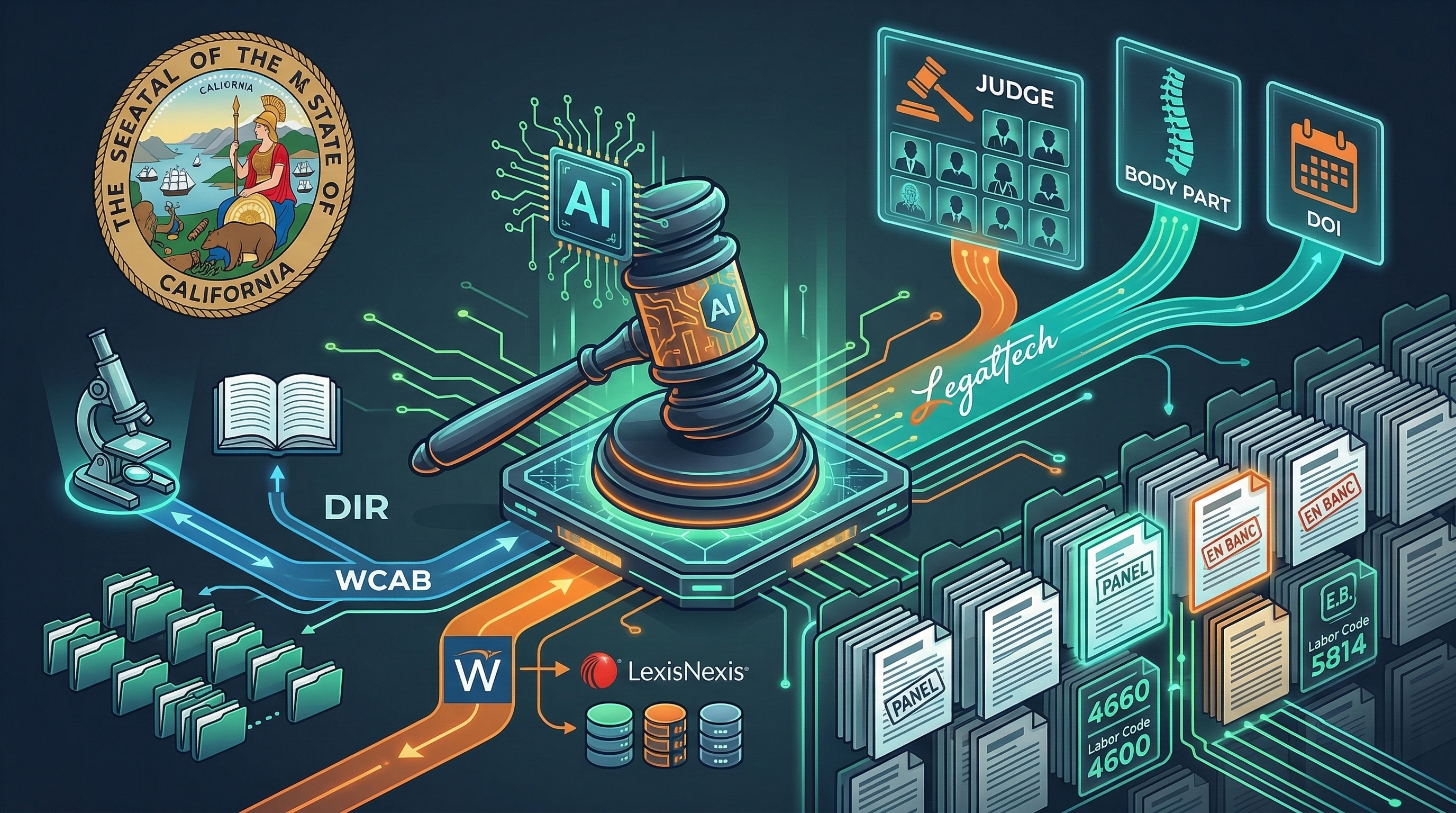
If you've ever spent two hours digging through the WCAB's case search portal trying to surface every panel decision a specific WCJ has issued on apportionment under Labor Code § 4663, you already know the pain — and you know the attorney who found those citations in ten minutes had a serious edge on you. That gap isn't about effort. It's about methodology and tools.
California's Workers' Compensation Appeals Board generates thousands of panel decisions annually, and those opinions — while not binding precedent like En Banc decisions — carry significant persuasive weight in hearings, MSC conferences, and trial briefs. Knowing which judges are issuing favorable or unfavorable panel opinions on disputed issues like permanent disability, SIBTF liability, or QME/AME apportionment findings can shape your litigation strategy before you ever walk into a WCAB district office [1]. But the infrastructure for finding these decisions by judge is fragmented: the WCAB's own portal, Lexis, Westlaw, and the DIR's online resources each surface different slices of the universe, with inconsistent indexing and no unified search layer.
This guide breaks down every available method for locating WCAB panel decisions by judge in California — from free DIR resources to professional databases — and shows you how AI-powered tools purpose-built for workers' comp are making the entire workflow dramatically faster and more complete.
Before you can build a research workflow around panel decisions, you need a firm grip on what you're actually searching for and why the tier of authority matters. Not all WCAB decisions carry equal weight, and conflating them in a brief or petition for reconsideration is the kind of mistake that signals inexperience to a commissioner.
At the top of the authority pyramid sit En Banc decisions — formal rulings by the full Appeals Board that are binding on all WCJs and commissioners statewide. When the Board issues an En Banc opinion on, say, the proper methodology for apportioning permanent disability under Labor Code § 4663, that ruling governs. Full stop.
Below En Banc authority are significant panel decisions, formally designated by the Appeals Board and published by the DIR [2]. These opinions are persuasive, not binding — but they're frequently cited in briefs and petitions precisely because the Board itself has flagged them as noteworthy. Think of them as the Board's own curated reading list for practitioners.
Finally, there are routine panel decisions — the vast majority of WCAB output. Not formally published, not designated significant, but absolutely accessible and absolutely usable when they're directly on point for your issue. A routine panel decision where a specific WCJ applied a particular approach to competing QME opinions on causation can be exactly the citation you need to anchor your argument, even if it'll never appear in a published reporter.
Knowing which tier you're citing is non-negotiable. A petition for reconsideration that treats a routine panel decision as binding authority will get torn apart. A trial brief that correctly deploys a significant panel decision as persuasive authority, alongside a directly analogous routine decision from the same WCJ, is a different story entirely.
Judges develop consistent patterns on contested issues. This isn't cynicism — it's jurisprudential reality. A WCJ who has consistently credited AME opinions over QME panel opinions in cases involving orthopedic permanent impairment isn't making random decisions. They've developed a framework, and that framework shows up across their decisions if you know how to look.
Defense practitioners can map how a WCJ treats IMR override petitions or SIBTF joinder arguments. Applicant attorneys can track favorable permanent disability rating decisions and identify judges who push back on aggressive apportionment arguments. Claims adjusters and legal ops teams at TPAs and self-insured employers can factor judicial tendencies directly into reserve-setting and settlement posture — which is institutional intelligence with real dollar value.
The math is simple: the fastest firm to identify and deploy these patterns walks into the hearing with a structural advantage. That advantage compounds across hundreds of cases per year.
The volume problem makes manual tracking unsustainable. Thousands of decisions per year across 24 WCAB district offices — the only way to stay current is a workflow that scales.
The WCAB's Electronic Adjudication Management System (EAMS) and the DIR's online case search tools are the logical starting point for most practitioners [3]. They're free, authoritative, and directly connected to the official record. They're also, frankly, limited in ways that will frustrate you fast.
The DIR's WCAB case search page allows you to query by district office, case number, and party name [4]. Here's how to extract maximum value from what the portal actually offers:
First, navigate to the DIR's WCAB case search page and select the specific district office where the WCJ you're researching is assigned. Decisions are tied to district offices, and filtering by office is your first narrowing mechanism. Second, use case number ranges tied to specific filing periods to approximate the decisions from a target judge's assignment rotation — judges rotate through assignments, so anchoring your search to a specific timeframe is essential. Third, download and review decision PDFs directly from the portal, but be prepared for inconsistent OCR quality on older decisions, which makes full-text searching within those PDFs unreliable. Fourth, cross-reference any retrieved decision against the WCAB's published list of significant panel decisions to confirm whether it's been formally designated — that distinction matters when you're building your citation hierarchy [5].
Here's the core gap: no native 'search by judge name' field exists in the standard WCAB portal. You cannot filter the universe of WCAB decisions by the authoring WCJ. You cannot run a full-text search for decisions mentioning specific Labor Code sections, medical findings, or QME names. There are no aggregated judge profiles, no decision histories, no trend analytics. What you have is a document retrieval system — useful, but not a research platform.
This is exactly the gap that professional databases and AI-powered platforms are built to fill.
If the DIR portal is a filing cabinet, Lexis and Westlaw are the research platforms built on top of it — with better indexing, full-text search, and judge-name filtering. Neither is perfect for workers' comp, but both are significantly more capable than the free portal.
Within Lexis Advance, select the California Workers' Compensation Cases database segment — this is your targeted universe, and staying inside it keeps your results relevant. From there, use the 'Judge' or 'Author' field filter combined with issue-specific Boolean search strings. A search structured as JUDGE(Smith) AND apportionment AND "Labor Code 4663" with a date restriction to the WCJ's current assignment period will surface a targeted set of relevant decisions. Export your results to a working research file and apply proper signal notation for any Lexis citations in WCAB briefs — signals matter in this jurisdiction.
Westlaw's California WC case database offers similar judge-name field searching with the added benefit of KeyCite integration for citation validation. But coverage of informal panel decisions — the non-significant, non-published routine opinions that often are the most directly analogous to your specific fact pattern — is inconsistent compared to En Banc and significant decisions.
The deeper limitation shared by both platforms: neither Lexis nor Westlaw surfaces cross-case analytics. You get documents. You don't get insights about judicial patterns. Assembling those patterns from a document set still requires manual synthesis — which, depending on the volume of decisions involved, can take hours. For solo practitioners and small firms, the cost-per-search model of exhaustive judge research projects on these platforms adds up fast.
Not every research need requires a Lexis or Westlaw subscription. The DIR and California's professional associations for workers' comp practitioners maintain resources that, used strategically, fill meaningful gaps in your research workflow.
The DIR publishes its significant panel decisions online, organized chronologically and freely accessible [2]. These are authoritative, curated, and free — the obvious starting point for any research project focused on formally designated opinions. The limitation is the one we've already flagged: decisions are filterable by year, not natively by judge. Working around this requires browser-based PDF search to locate judge names within published decision documents — a functional but slow workaround.
Bookmark this resource and audit it periodically. New significant decisions are added on a rolling basis without email alerts, so practitioners who check regularly stay current while those who don't fall behind.
The California Applicants' Attorneys Association (CAAA) provides its members with curated decision libraries and legislative updates that are specifically oriented toward applicant-side practice. The California Workers' Compensation Institute (CWCI) publishes analytics-level research on claims trends that provides context for understanding why certain panel decision patterns are emerging at a systemic level. The State Bar's Workers' Compensation Section publishes newsletters that flag newly significant panel opinions with annotations.
These resources supplement but don't replace the need for a searchable, full-text database tied to real case law. They're your professional intelligence layer, not your primary research engine.
Ad hoc judge research is the enemy of efficiency. Every practitioner has done it: a hearing is approaching, you remember you should check what this WCJ has done on apportionment, and you spend 90 minutes piecing together a fragmentary picture from four different sources. That's not a workflow. That's organized chaos.
Here's the scalable alternative. Identify the top 5–10 WCJs whose courtrooms your firm appears in most frequently across all district offices. For each judge, build a documented profile cataloging their patterns on your firm's top five most litigated issues — apportionment under §§ 4663 and 4664, TTD disputes, SIBTF joinder, QME/AME credibility, and IMR override petitions are the common denominators for most California WC practices. Update these profiles quarterly as new decisions are issued and as judges rotate assignments. Share them across your entire litigation team.
This is institutional intelligence, not individual heroics. The firm that builds this infrastructure doesn't rely on any one attorney's memory — it deploys a shared knowledge base that makes every attorney on every case more effective.
One of the highest-value applications of judge-specific research is understanding how a specific WCJ handles conflicting QME and AME opinions on causation or permanent impairment. This cross-referencing work — identifying decisions where the judge addressed IMR or IMRO outcomes alongside QME credibility findings, or flagging decisions where the judge applied or rejected apportionment arguments supported by specific medical evidence — is where general tools break down entirely.
You need a tool that can search across hundreds of panel decisions simultaneously, identify patterns in how a judge treats specific categories of medical evidence, and surface those insights in a format you can deploy directly in a brief. This is the use case that general legal research platforms were simply not designed for.
Generic AI tools fail workers' comp practitioners in a specific and dangerous way: they hallucinate citations. A ChatGPT-generated case name that doesn't exist is a career-ending error when it appears in a petition for reconsideration filed before a WCJ who knows the case law cold. The risk isn't theoretical — it's happened to practitioners in multiple jurisdictions [5].
What a purpose-built workers' comp AI platform does differently is foundational: it's trained exclusively on California workers' comp case law, Labor Code, WCAB decisions, and regulatory history. No out-of-jurisdiction noise. No fabricated citations. No hallucinated holdings. Just real decisions, correctly cited, with accurate docket numbers.
The difference between a general AI tool and a WC-specific platform isn't a matter of degree — it's a categorical distinction. A general AI generates plausible-sounding case names. A WC-specific AI trained on verified WCAB decision data returns the actual panel decision with the correct docket number, the actual holding, and the correct Labor Code sections implicated.
For practitioners, citation accuracy isn't a nice-to-have. It's the minimum viable standard. A single fabricated citation in a brief doesn't just lose the argument — it destroys your credibility with the WCJ for every argument that follows.
Here's what this looks like in practice. You input a WCJ name, a contested issue (apportionment under § 4663, competing QME opinions on orthopedic permanent impairment), and a date range corresponding to the judge's current assignment period. In seconds, you get a curated set of matching panel decisions with holdings summarized, relevant Labor Code sections flagged, and cross-references to related En Banc or significant decisions already surfaced.
You use those results directly in your petition for reconsideration, trial brief, or settlement evaluation memo — no additional reformatting required. Compare that to the legacy workflow: 45 minutes on the WCAB portal turning up incomplete results, 30 minutes on Lexis constructing and refining Boolean queries, 20 minutes manually validating citations. The math isn't close.
If your practice handles significant WCAB volume, Start Researching with CompFox and measure the difference against your current workflow in real time.
Even practitioners with solid research instincts fall into predictable traps with WCAB judge research. Knowing these in advance is part of building a workflow that holds up under pressure.
Relying solely on the free DIR portal will leave non-significant panel decisions — often the most directly analogous to your specific fact pattern — completely off your radar. Significant panel decisions are the curated highlights; the routine decisions are where the real jurisprudential texture lives.
Failing to filter by assignment period when searching by judge name is a reliability problem. Judges rotate, and a decision from five years ago may reflect a jurisprudential approach the judge has since revised or abandoned. Match your date range to the current assignment.
Citing panel decisions without checking subsequent history is a basic due diligence failure. Has the decision been vacated? Has an En Banc opinion subsequently addressed the same issue and gone the other way? Has a more recent significant panel decision contradicted the holding you're relying on? Validation is not optional.
Treating judge research as a one-time task misunderstands the nature of the intelligence you're building. Judicial tendencies evolve, assignment rotations change, and the case law landscape shifts with every significant new decision. Quarterly updates to your WCJ profiles are a minimum cadence for active practitioners.
Ignoring the date-of-injury implications of Labor Code changes is a doctrinal trap that catches even experienced practitioners. Apportionment law pre- and post-SB 899 produces categorically different outcomes. A panel decision that looks directly on point may have been decided under a different statutory framework than the one governing your case. Always cross-reference the applicable version of the Labor Code in effect at the date of injury.
Finding WCAB panel decisions by judge in California is not a single-step search — it's a multi-source research discipline that spans the DIR portal [4], professional databases like Lexis and Westlaw, free association resources, and increasingly, AI platforms purpose-built for workers' comp. The practitioners and firms who build repeatable, scalable workflows for this research — and who leverage the right tools to compress hours into minutes — walk into every hearing, MSC conference, and trial brief deadline with a structural advantage their slower competitors simply don't have.
From understanding the En Banc vs. significant vs. routine panel decision hierarchy, to constructing WCJ tendency profiles, to cross-referencing medical findings with judicial patterns, the methodology in this guide is the foundation of modern WCAB litigation intelligence. The practitioners who internalize it don't just research faster — they litigate smarter.
Stop leaving hours on the table with fragmented searches across five different platforms. CompFox delivers purpose-built AI search trained exclusively on California workers' comp case law — find WCAB panel decisions by judge, issue, and Labor Code section in seconds, with zero hallucinated citations. Start Researching today and see exactly what your current workflow is costing you.
WCAB panel decisions are rulings issued by California's Workers' Compensation Appeals Board, but they are not all equal in authority. At the top of the hierarchy are En Banc decisions, which are binding on all WCJs and commissioners statewide. Below those are significant panel decisions — formally designated and published by the DIR — which carry persuasive but not binding authority. Finally, routine panel decisions make up the vast majority of WCAB output. These are not formally published or designated as significant, but they are still accessible and usable in briefs, petitions for reconsideration, and trial strategy. Misrepresenting the authority tier of a panel decision — for example, citing a routine panel opinion as binding precedent — is a serious error that can undermine your credibility before a commissioner. Understanding the distinction is essential before building any research workflow around finding WCAB panel decisions by judge in California.
Judges develop consistent patterns on contested legal issues over time. A WCJ who repeatedly credits AME opinions over QME panel opinions in orthopedic permanent impairment cases is not acting randomly — they have developed a framework that appears across their decisions. By learning how to find WCAB panel decisions by judge in California, both applicant and defense attorneys can map those patterns before walking into a hearing. This intelligence shapes litigation strategy in concrete ways: how you frame your trial brief, which medical opinions you emphasize, and how you approach MSC conferences. For example, if you're litigating apportionment under Labor Code § 4663, knowing which panel opinions a specific WCJ has issued on that issue — and how they ruled — gives you a significant edge over opposing counsel who hasn't done that research.
The California Department of Industrial Relations (DIR) website is the primary free resource for locating WCAB panel decisions. The DIR publishes significant panel decisions that have been formally designated by the Appeals Board, making those relatively straightforward to find. The WCAB's own case search portal also provides access to decisions, though its indexing is inconsistent and does not offer a unified search layer that lets you filter comprehensively by judge across all decision types. These free tools are a reasonable starting point, but practitioners should be aware that they surface only a slice of the total universe of panel decisions. Routine panel decisions — often the most directly on-point citations for specific factual and legal issues — are harder to locate through free portals alone, which is why many practitioners supplement with professional legal databases.
Professional legal databases like Lexis and Westlaw provide broader access to WCAB panel decisions than free DIR resources, but each platform surfaces a different subset of the total universe of decisions, and none offers a fully unified search layer. These databases allow you to search by judge name, legal issue, Labor Code section, and date range, making it easier to build a picture of a specific WCJ's decision-making patterns. However, inconsistent indexing means that relying on any single platform can leave gaps. For practitioners who need comprehensive judge-specific research — for example, pulling every panel decision a WCJ has issued on SIBTF liability or QME apportionment findings — combining multiple databases and free DIR resources is the more reliable approach. AI-powered tools purpose-built for California workers' compensation are also emerging as a faster alternative to manual database searches.
Significant panel decisions are formally designated by the Appeals Board and published by the DIR. They carry clear persuasive authority and are frequently cited in briefs and petitions because the Board itself has flagged them as important — essentially a curated reading list for practitioners. Routine panel decisions, by contrast, are not formally published or designated, but they are still accessible and highly valuable. A routine decision in which a specific WCJ applied a particular analytical framework to competing medical opinions can be exactly the citation you need to support your argument at trial or in a petition for reconsideration. The key is to cite each tier correctly: significant panel decisions as persuasive authority, and routine decisions as analogous authority — never as binding precedent. Knowing this distinction is fundamental to effective WCAB panel decision research in California.
AI-powered legal research tools purpose-built for California workers' compensation are designed to address the core problem with existing resources: fragmentation. The WCAB portal, Lexis, Westlaw, and DIR resources each index different portions of the total decision universe, with no unified search layer across all of them. AI tools can aggregate and search across these sources simultaneously, dramatically reducing the time it takes to locate every relevant panel decision a specific judge has issued on a contested issue. A search that might take two hours of manual portal digging can potentially be completed in minutes with the right tool. For practitioners researching judge-specific patterns on issues like permanent disability, apportionment under Labor Code § 4663, or QME credibility determinations, this speed and completeness translates directly into strategic and competitive advantage at hearings, MSC conferences, and trial.
Several critical mistakes can undermine WCAB panel decision research in California. First, conflating authority tiers is a serious error — citing a routine panel decision as binding authority, or failing to distinguish it from an En Banc ruling, signals inexperience to commissioners and opposing counsel. Second, relying on a single database or the WCAB portal alone leads to incomplete research, since each platform indexes only a portion of available decisions. Third, ignoring routine panel decisions in favor of only formally published significant decisions means missing the most directly on-point citations for specific factual scenarios. Fourth, failing to research judge-specific patterns before hearings leaves practitioners unprepared for predictable judicial frameworks on contested issues. A complete research methodology combines free DIR resources, professional databases like Lexis and Westlaw, and where possible, AI-powered tools designed specifically for California workers' compensation practice.
WCAB panel decisions — particularly those issued by the specific WCJ presiding over your case — are directly relevant to how you prepare for hearings, mandatory settlement conferences, and trial briefs. If research reveals that a judge has consistently ruled in a particular direction on apportionment disputes or QME versus AME credibility questions, that pattern should inform how you structure your arguments, which evidence you emphasize, and even how aggressively you pursue settlement. Significant panel decisions provide persuasive authority you can cite directly in briefs and petitions for reconsideration. Routine panel decisions from the same judge provide analogous support for your position and demonstrate how that judge has previously analyzed similar issues. Knowing how to find WCAB panel decisions by judge in California is not just a research skill — it is a core component of effective litigation strategy in California workers' compensation practice.
[1] https://www.dir.ca.gov/wcab/wcab-Decisions.htm. dir.ca.gov. https://www.dir.ca.gov/wcab/wcab-Decisions.htm
[2] https://www.dir.ca.gov/wcab/wcab.htm. dir.ca.gov. https://www.dir.ca.gov/wcab/wcab.htm
[3] https://eams.dwc.ca.gov/WebEnhancement/. eams.dwc.ca.gov. https://eams.dwc.ca.gov/WebEnhancement/
[4] https://www.dir.ca.gov/wcab/wcab_panel.htm. dir.ca.gov. https://www.dir.ca.gov/wcab/wcab_panel.htm
[5] https://www.dir.ca.gov/wcab/wcab_dars.htm. dir.ca.gov. https://www.dir.ca.gov/wcab/wcab_dars.htm
The landscape of apportionment in California workers' compensation law is undergoing a subtle but significant transformation.
Navigate California unemployment benefits with our complete 2026 guide. Learn eligibility requirements, weekly benefit amounts, claims process, and how the EDD determines your entitlements. Essential for claimants, employers, and legal professionals.
Apply these legal strategies instantly. CompFox helps you find decisions, analyze reports, and draft pleadings in minutes.