Case Law
The Shift in Apportionment: Analyzing the Recent En Banc Decisions
The landscape of apportionment in California workers' compensation law is undergoing a subtle but significant transformation.

Chris Lyle
Co-Founder & CEO
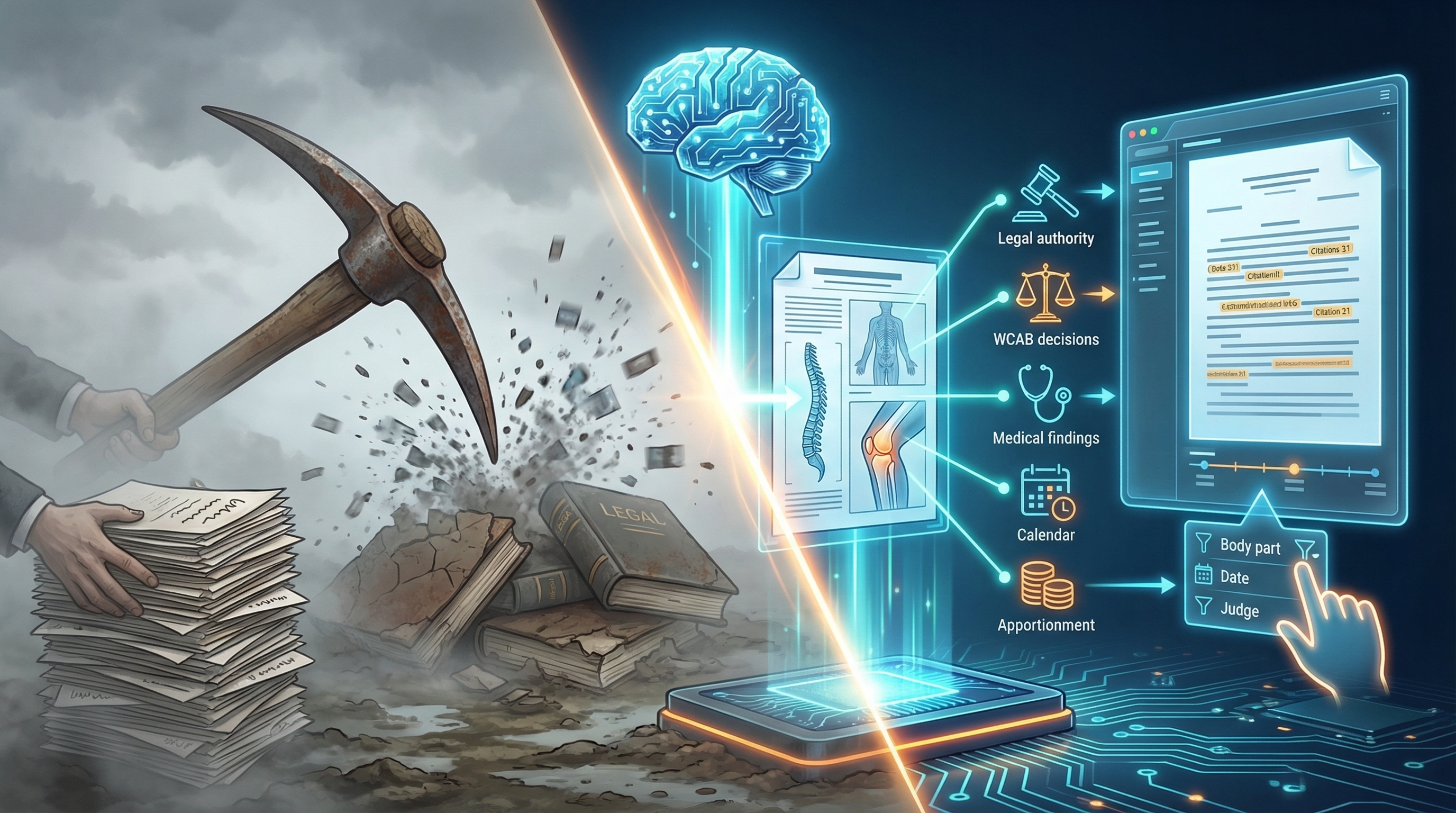
While BigLaw firms pour resources into generic AI platforms, workers' comp practitioners are quietly discovering that vertical AI — purpose-built for Labor Code sections, QME reports, and apportionment disputes — is the real competitive edge in 2026. The story being told in most legal tech circles focuses on the headline names: Harvey, CoCounsel, Lexis+ AI. What that story misses is the practitioner sitting across from you at the MSC who just cited six on-point WCAB panel decisions you've never seen — because your AI couldn't find them.
The workers' compensation docket moves fast. Between QME/AME report reviews, Permanent Disability Rating disputes, apportionment arguments under LC §4663, and En Banc decisions that can reshape your entire case strategy overnight, the research burden on solo practitioners and mid-size WC firms has never been heavier. General-purpose AI tools like Claude, Copilot, and even Lexis+ AI were built for the full spectrum of legal practice — which means they're optimized for no one in particular. For workers' comp attorneys, that breadth is a liability, not a feature.
This guide breaks down what separates a purpose-built AI legal research tool for workers' comp from generic alternatives, what features actually move the needle in WC practice, and how the fastest firms in California and beyond are compressing hours of research into seconds — without hallucinated citations tanking their credibility before the WCAB.
The pitch from enterprise legal AI vendors sounds compelling: one platform, all your research needs, powered by the latest large language model. The reality for WC practitioners is less flattering. Generic platforms like Lexis+ AI and CoCounsel are trained on broad legal corpora that treat WCAB panel decisions, En Banc rulings, and California Labor Code nuance as edge cases in a much larger dataset [1]. That structural choice has downstream consequences that compound every time you run a research query.
Workers' comp has a unique legal taxonomy that general tools simply don't model with the depth practice demands. Apportionment under LC §4663, PDRS calculations, QME/AME evidentiary standards under LC §§4060–4067 — these are deeply interconnected frameworks where precision matters. A generic AI that conflates apportionment under §4663 with industrial causation analysis under §4660 isn't just imprecise; it's generating research that can actively mislead your legal strategy.
Then there's the volume problem. WC practitioners routinely process 200–500 page QME reports, extensive medical records, and multi-session deposition transcripts. General tools weren't designed to cross-reference these documents at speed, extract apportionment percentages, or surface contradictions between a QME's current conclusions and prior treating physician opinions [2]. And cost-per-query pricing models from enterprise platforms punish the high-frequency research workflows that WC defense and applicant-side work demands daily.
Every legal AI carries some hallucination risk. In workers' comp, that risk is amplified in ways that should alarm any practitioner relying on generic tools. Generic LLMs trained on broad legal text will confidently cite WCAB panel decisions that don't exist — complete with case names, panel compositions, and holdings that sound entirely plausible to anyone who hasn't personally verified them.
In a practice area where a single En Banc decision like Hikida or Nunes can anchor your entire legal theory, a fabricated citation is more than embarrassing. Before the WCAB, submitting a nonexistent authority is potentially sanctionable and certainly reputation-damaging in a bar community small enough that word travels fast [3]. Purpose-built WC AI tools address this through retrieval-augmented generation (RAG) architecture — querying verified, jurisdiction-specific case law databases rather than generating plausible text — which structurally eliminates the fabrication failure mode.
When evaluating any AI tool, ask two questions directly: what hallucination-resistance architecture does your vendor use, and what is their case law corpus cutoff date? If you don't get clear, technical answers to both, keep walking.
Labor Code §§4060–4067 QME dispute procedures, §4663/4664 apportionment standards, and the PDRS aren't just specialized topics — they're an interconnected system where changes in one area cascade through the others. Generic AI doesn't model these relationships. It treats them as isolated statutory provisions, missing the doctrinal architecture that experienced WC practitioners navigate intuitively.
WCAB panel decisions and En Banc rulings carry a form of persuasive and quasi-precedential weight that isn't replicated in any other practice area's secondary authority structure. A solo applicant's attorney who can cite twelve on-point panel decisions supporting their apportionment position has a material advantage over defense counsel whose research tool only surfaces published Court of Appeal opinions. Applicant and defense strategies both pivot on medical-legal findings that require cross-referencing physician conclusions against controlling WCAB authority — a workflow that demands WC-specific training data, not a general legal corpus [4].
Not all AI legal research tools are created equal, and vendor marketing in this space moves faster than most firms' ability to evaluate the underlying claims. Here's the evaluation framework that actually maps to how WC practitioners work.
WC-specific case law coverage is the non-negotiable starting point. Does the tool index WCAB panel decisions, En Banc rulings, and appellate court decisions interpreting the Labor Code — not just published appellate opinions available in Westlaw? This is where most general platforms immediately fall short.
Hallucination-resistant architecture means retrieval-augmented generation with source citations you can independently verify, not generative summaries with no audit trail. Every case the tool surfaces should link to an actual, accessible decision.
Document ingestion and cross-referencing capability is where practice-day leverage lives. Can the tool ingest your actual QME/AME reports and cross-reference medical findings against case law in real time? This is the feature that eliminates paralegal hours, not just speeds up attorney research.
Pricing and query volume must match WC firm economics. Research is continuous in WC litigation — a tool that charges per query or per document will quickly become cost-prohibitive for the volume of work solo and mid-size WC firms actually run.
Jurisdiction depth is critical for California practitioners especially. California WC law is its own universe, and tools trained on multi-state general workers' comp law may miss California-specific WCAB authority entirely [2].
A WC AI research tool is only as good as its underlying database. Demand specifics: which WCAB panel decisions are indexed? How frequently is the corpus updated? A tool that misses a recent En Banc decision could lead you to argue a position the Board has already foreclosed — a painful and avoidable mistake.
The database moat that matters in workers' comp isn't Westlaw's depth in federal circuit opinions or Lexis's coverage of secondary sources. It's the index of thousands of WCAB panel decisions that never appear in general legal research platforms. That's where CompFox-class tools create the competitive gap that translates directly to case outcomes.
If there's one feature that separates purpose-built WC AI from everything else in the market, it's the ability to upload a 400-page QME report and instantly surface the physician's apportionment conclusions, disputed body parts, and contradictions with prior medical opinions. This is a genuine superpower for both defense and applicant practitioners.
Cross-referencing those medical findings against controlling WCAB authority — in seconds — eliminates the paralegal hours previously consumed by manual report review [5]. Tools that can compare findings across multiple QME/AME reports in the same case file, identifying inconsistencies that become deposition ammunition, represent a qualitative leap in how WC litigation is prepared and executed.
The market has bifurcated into three categories: general legal AI platforms (Lexis+ AI, CoCounsel, Harvey), general-purpose AI assistants (Claude, Gemini, Copilot), and vertical WC-specific tools (CompFox). Understanding where each category sits on the tradeoff curve is essential to making the right choice for your firm.
General-purpose AI assistants — Claude, Gemini, Copilot — are powerful drafting and summarization tools with one critical flaw for WC practice: they have no access to proprietary WCAB case law databases and hallucinate WC citations at high rates. Using them for document summarization is defensible. Using them for WCAB legal research is professionally risky.
Lexis+ AI and CoCounsel are sophisticated tools built for large firm workflows across all practice areas [1]. Their WC coverage is a subset of a much larger system optimized for BigLaw's research patterns — which means deep federal statutory coverage, strong contract and corporate analysis capability, and solid multi-jurisdiction research across commercial practice areas.
For WC practitioners, this translates to paying for capabilities you don't use while lacking the depth you actually need. WCAB panel decision coverage is thin. Apportionment doctrine cross-referencing doesn't exist as a native workflow. QME/AME report ingestion isn't a designed use case. And pricing models built for AmLaw 200 economics can be genuinely prohibitive for the solo WC practitioner or 10-attorney defense firm.
Purpose-built exclusively for workers' comp, CompFox represents the other end of the spectrum: the entire model, database, and UX is designed around QME/AME workflows, WCAB research, and Labor Code navigation. This isn't a generic legal AI with a WC-themed interface. The underlying architecture was built for the specific research and document workflows WC practitioners run every day.
The proprietary WCAB panel decision database indexes authority that simply doesn't exist in general legal research platforms — giving CompFox users access to persuasive and binding authority their opponents can't find with Lexis or Westlaw. That's not a marginal advantage; at an MSC where the persuasion battle turns on whose counsel has more on-point panel decisions, it's potentially decisive.
Hallucination-resistant architecture means every case citation is verifiable — no fabricated authority, no sanctions risk, no credibility damage before the Board. And pricing is built for WC firm economics: solo practitioners and mid-size firms access enterprise-grade AI research without enterprise-grade contracts. If you're ready to see what that looks like on your actual case files, start researching with CompFox today — the first query will tell you everything you need to know.
The research bottleneck in WC defense and applicant work isn't lack of knowledge — it's time. Finding the right WCAB panel decision to support your apportionment argument should take minutes, not the better part of an afternoon. The fastest firm wins, and in a practice area where statute of limitations, lien resolution timelines, and expedited hearing schedules create hard deadlines, speed is a strategic asset, not just a productivity metric.
Practitioners across both defense and applicant work report spending 3–5 hours manually reviewing and summarizing a complex QME report — identifying apportionment percentages, causation opinions, work restrictions, future medical recommendations, and contradictions with prior opinions [4]. AI ingestion and analysis reduces this to under 15 minutes.
Instant extraction eliminates transcription error and ensures nothing is missed. But the real leverage comes from the next step: cross-referencing the physician's apportionment methodology against LC §4663 and controlling WCAB authority in the same workflow. Report review stops being document management and becomes immediate legal strategy. That's the transformation that changes how a WC practice operates at scale.
WCAB panel decisions are technically non-precedential but functionally persuasive — and the attorney who can cite twelve on-point panel decisions at MSC wins the persuasion battle in a way that a single published appellate opinion rarely achieves. The volume of on-point authority matters, and it matters directly to outcomes.
CompFox's panel decision database surfaces this authority instantly. Practitioners using Westlaw or Lexis simply don't have access to this volume of WCAB-specific decisions — which means their research products are structurally incomplete, regardless of how sophisticated their research skills are.
En Banc research becomes proactive rather than reactive. AI tools can surface how a recent En Banc decision affects your open case inventory across multiple files simultaneously — turning what would previously be an urgent research project into a routine alert. That's the kind of leverage that compounds across a full case docket.
State bars including California are actively issuing guidance on AI use in legal practice, and WC attorneys carry the same professional responsibility obligations as practitioners in any other area. The ethical framework here isn't complicated, but it does require practitioners to be deliberate.
The duty of competence under California Rule 1.1 now arguably includes understanding the AI tools you deploy in client representation. Knowing your tool's architecture — specifically whether it uses RAG against a verified corpus or generates text from a pretrained model — is part of competent deployment, not a technical nicety.
The duty of supervision applies to AI outputs without exception. AI is a force multiplier, not a replacement for professional judgment. Citation verification is non-negotiable: never file a brief citing AI-generated case law without independently confirming the decision exists and says what the AI claims [3]. Purpose-built tools with verifiable citations make this obligation easier to discharge; generic tools with no audit trail make it substantially harder.
Confidentiality considerations are real and shouldn't be minimized. Understand your vendor's data handling policies before uploading client QME reports, medical records, or case files. HIPAA and attorney-client privilege implications apply to every document that leaves your firm's systems.
The ethical upside is worth naming: AI tools that reduce research errors, improve citation accuracy, and surface more complete authority may actually enhance your competence rather than threaten it — provided you're using tools built to the standard your practice demands.
Implementation discipline determines whether a new tool becomes practice infrastructure or expensive shelf software. The evaluation and adoption path for WC AI tools is straightforward if you stay focused on the workflows that matter most.
Start with your highest-pain workflow. For most WC practitioners, that's QME report review or WCAB case law research. Pick the tool that demonstrably wins on your biggest bottleneck, not the one with the best demo presentation. Demand a trial period with real case files — vendor demos using curated examples don't reveal how a tool performs on your actual QME reports and your actual research questions.
Evaluate the database, not just the interface. Ask specifically about WCAB panel decision coverage, En Banc indexing, and corpus update frequency. A tool with a beautiful UX and a thin corpus is a liability dressed as a feature.
Calculate the ROI on attorney time with discipline. If a tool saves a senior associate 10 hours per week on research and document review at a billing rate of $300–400/hour, the math on subscription cost versus value recovered is usually decisive within the first month. Small firms should start with one practice workflow — QME analysis or WCAB research — achieve proficiency, then expand to drafting and cross-case analysis. Avoid the adoption failure mode of trying to change every workflow at once.
Peer benchmarking matters in a bar community this size. Talk to other WC practitioners using the tool, not just the vendor. The WC defense and applicant bar in California is a small community where real-world performance data spreads quickly. If a tool is genuinely performing at the level vendors claim, you'll hear it from practitioners you trust.
When you're ready to run that evaluation on real case files, try CompFox free and benchmark it against whatever you're currently using — the WCAB panel decision search alone will reset your expectations for what WC-specific AI research should look like.
The AI legal research tool landscape in 2026 has bifurcated clearly. General platforms offer broad capability at the cost of workers' comp depth. Vertical tools purpose-built for WC practice offer jurisdiction-specific case law coverage, hallucination-resistant architecture, and document analysis workflows that actually match how WC attorneys work — and how WC cases are won.
For practitioners dealing with QME/AME report overload, WCAB research bottlenecks, and the relentless deadline pressure of workers' comp litigation, the choice is increasingly clear. The attorney using a general-purpose AI tool to research apportionment under LC §4663 is fighting with one hand behind their back against an opponent running purpose-built AI against a proprietary WCAB panel decision database. That gap in authority coverage and research speed translates directly to outcomes at MSC, at trial, and in settlement negotiations.
Generic AI was built for someone else's practice. Stop letting it slow down yours. CompFox is built exclusively for WC practitioners — run your next WCAB research query in seconds, not hours, and see what the fastest firms already know.
An AI legal research tool for workers' comp attorneys is a purpose-built, vertically specialized platform designed specifically to handle the unique legal frameworks of workers' compensation practice — including Labor Code sections, WCAB panel decisions, QME/AME report analysis, Permanent Disability Rating disputes, and apportionment arguments under LC §4663. Unlike generic AI platforms such as Harvey, CoCounsel, or Lexis+ AI, which are trained on broad legal corpora covering the full spectrum of practice areas, a workers' comp-specific tool is optimized for the precise taxonomy, case law, and evidentiary standards that WC practitioners deal with daily. Generic tools treat WCAB panel decisions and California Labor Code nuance as edge cases in a much larger dataset — a structural limitation that leads to imprecise, potentially misleading research output. A purpose-built AI legal research tool for workers' comp attorneys understands how frameworks like apportionment under §4663, industrial causation under §4660, and QME evidentiary standards under LC §§4060–4067 interconnect, delivering more reliable and actionable research results.
Generic AI tools fall short for workers' comp attorneys for several key reasons. First, they are trained on broad legal datasets where workers' comp-specific materials — WCAB panel decisions, En Banc rulings, California Labor Code nuances — are underrepresented edge cases rather than core training data. This means their understanding of deeply interconnected WC frameworks is shallow. Second, they lack the document-processing capabilities WC practitioners need daily: analyzing 200–500 page QME reports, cross-referencing medical records, and surfacing contradictions between a QME's conclusions and prior treating physician opinions. Third, enterprise platforms often use cost-per-query pricing models that penalize the high-frequency research workflows common in workers' comp defense and applicant-side work. Finally, their hallucination risk is amplified in a practice area where fabricating a WCAB panel decision could be sanctionable before the board and severely damage an attorney's reputation in a tight-knit legal community.
The hallucination problem is particularly dangerous for workers' comp attorneys relying on generic AI tools. Generic large language models can confidently generate fabricated WCAB panel decisions — complete with realistic-sounding case names, panel compositions, and plausible holdings — that simply do not exist. In most practice areas, a hallucinated citation is embarrassing. In workers' comp, it can be catastrophic. The WCAB is a specialized forum where submitting a nonexistent authority can be potentially sanctionable. Beyond legal consequences, the workers' comp bar is a small community where reputation damage travels quickly. Because single landmark decisions like Hikida or Nunes can anchor an entire legal theory, accuracy in citation is non-negotiable. A purpose-built AI legal research tool for workers' comp attorneys addresses this by being trained on verified, WC-specific legal sources rather than broad corpora that produce plausible-sounding but unverifiable results.
A reliable AI legal research tool for workers' comp attorneys should handle several practice-critical tasks. These include researching WCAB panel decisions and En Banc rulings with accuracy and speed, analyzing apportionment arguments under LC §4663, supporting Permanent Disability Rating disputes, and applying the correct evidentiary standards under LC §§4060–4067 for QME and AME reports. The tool should also be capable of processing large documents — including 200–500 page QME reports, extensive medical records, and multi-session deposition transcripts — to extract key data points like apportionment percentages and surface contradictions between expert opinions. Additionally, it should surface on-point, verified case authority quickly enough to keep pace with a fast-moving workers' comp docket, including MSC hearings where opposing counsel may cite recent panel decisions you haven't yet reviewed.
The fastest-moving workers' comp firms in California and beyond are using purpose-built AI legal research tools to compress hours of research into seconds. Rather than spending significant time manually combing through WCAB decisions, Labor Code provisions, and medical documentation, attorneys can run targeted queries and receive verified, relevant results almost instantly. This speed advantage becomes apparent at critical practice moments — like mandatory settlement conferences, where an attorney equipped with a WC-specific AI tool may be able to cite six on-point WCAB panel decisions their opponent hasn't seen. Beyond research speed, these tools help practitioners efficiently review lengthy QME reports and medical records, spot inconsistencies in expert testimony, and stay current with En Banc decisions that can reshape case strategy overnight. For solo practitioners and mid-size WC firms with limited research bandwidth, this competitive edge is substantial.
Yes, particularly for solo practitioners and small workers' comp firms, a specialized AI legal research tool can be one of the highest-ROI investments available. The research burden on WC practitioners has never been heavier — between QME report reviews, apportionment disputes, PD rating challenges, and rapidly evolving WCAB case law, keeping up without support is increasingly difficult. Generic enterprise tools compound the problem by using cost-per-query pricing models that make high-frequency research workflows expensive. A purpose-built AI legal research tool for workers' comp attorneys, by contrast, is designed around the actual volume and cadence of WC research needs. For a solo practitioner, the ability to surface accurate, verified research quickly — without risking hallucinated citations before the WCAB — can be the difference between winning and losing cases, and between building or damaging a professional reputation.
When evaluating an AI legal research tool for workers' comp attorneys, several factors matter most. First, look for vertical specialization: the tool should be trained on WC-specific legal materials, including WCAB panel decisions, En Banc rulings, and California Labor Code frameworks, not just broad legal corpora. Second, verify citation accuracy — the tool must produce verified, real case citations, not hallucinated authorities that could expose you to sanctions or reputational harm before the WCAB. Third, assess document-handling capabilities: can the platform process large QME reports, medical records, and deposition transcripts efficiently? Fourth, evaluate pricing structure to ensure it supports high-frequency research workflows without punishing volume. Finally, look for depth in key WC frameworks, including apportionment under LC §4663, PDRS calculations, and QME/AME evidentiary standards under LC §§4060–4067, to confirm the tool actually understands the interconnected nature of workers' comp law rather than treating it as a generic legal topic.
[1] https://www.lexisnexis.com/en-us/products/lexis-plus-ai.page. lexisnexis.com. https://www.lexisnexis.com/en-us/products/lexis-plus-ai.page
[2] https://casely.ai/solutions/ai-legal-research-workers-compensation-law. casely.ai. https://casely.ai/solutions/ai-legal-research-workers-compensation-law
[3] https://sonix.ai/ai/ai-for-workers-compensation-lawyers/. sonix.ai. https://sonix.ai/ai/ai-for-workers-compensation-lawyers/
[4] https://www.digitalowl.com/blog/best-ai-tools-for-your-lawsuit. digitalowl.com. https://www.digitalowl.com/blog/best-ai-tools-for-your-lawsuit
[5] https://szcomplaw.com/the-role-of-technology-and-ai-in-workers-compensation-defense/. szcomplaw.com. https://szcomplaw.com/the-role-of-technology-and-ai-in-workers-compensation-defense/
The landscape of apportionment in California workers' compensation law is undergoing a subtle but significant transformation.
Navigate California unemployment benefits with our complete 2026 guide. Learn eligibility requirements, weekly benefit amounts, claims process, and how the EDD determines your entitlements. Essential for claimants, employers, and legal professionals.
Apply these legal strategies instantly. CompFox helps you find decisions, analyze reports, and draft pleadings in minutes.