Case Law
The Shift in Apportionment: Analyzing the Recent En Banc Decisions
The landscape of apportionment in California workers' compensation law is undergoing a subtle but significant transformation.

Chris Lyle
Co-Founder & CEO
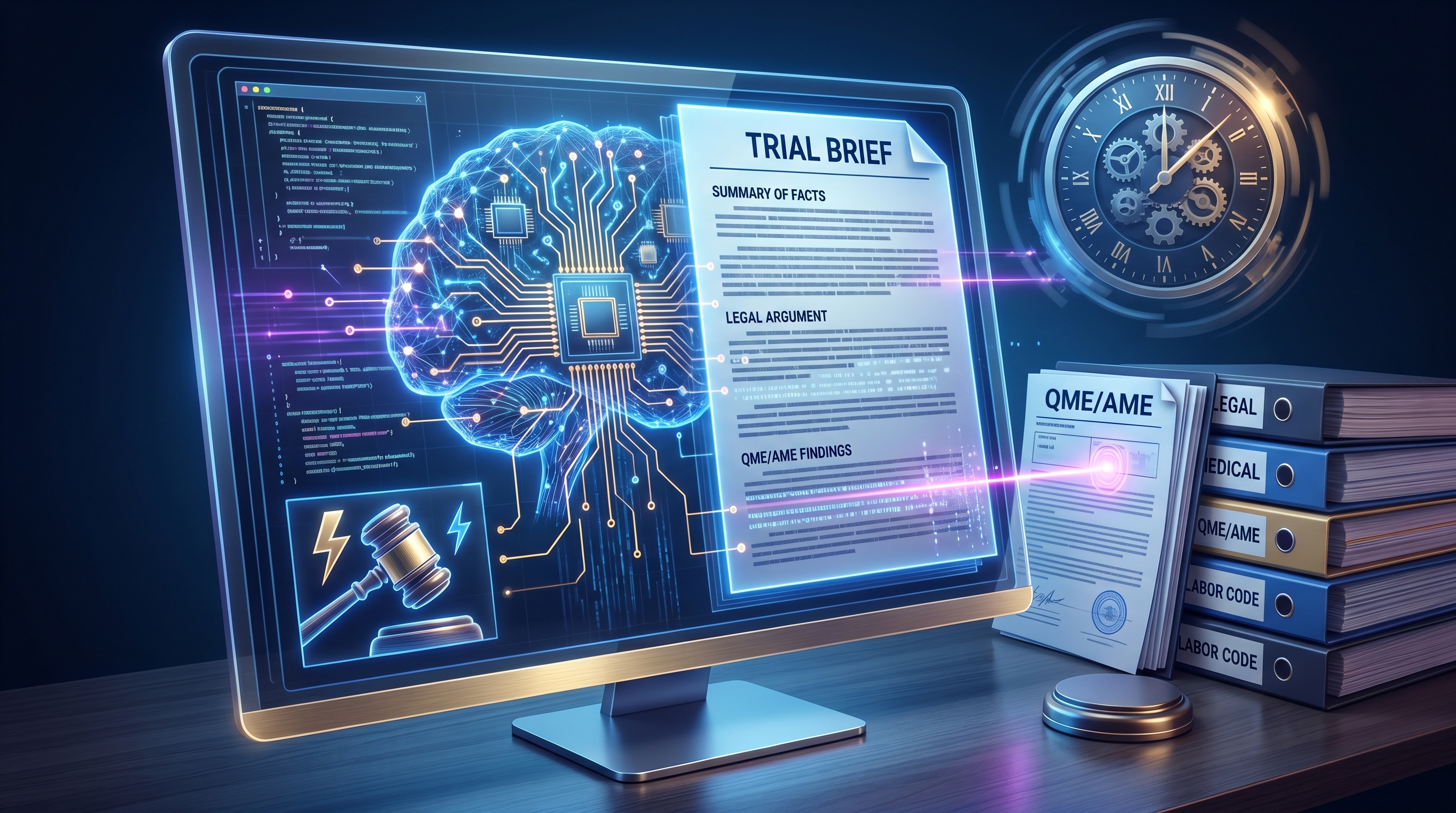
Every WCAB trial brief your firm produces is a remix of the same legal arguments, medical findings, and Labor Code citations. Yet most practitioners still spend 4–6 hours drafting each one from scratch. Multiply that across 50 to 100 active files. You are not running a law practice at that point. You are running a document factory that happens to have a bar card.
Workers' compensation trial briefs demand precision. They require accurate apportionment analysis under Labor Code §4663. Apportionment is the process of dividing a disability between industrial and non-industrial causes. They require citations to controlling En Banc decisions. En Banc decisions are rulings issued by the full WCAB that bind all future cases. They require cross-referenced QME and AME findings. QMEs are Qualified Medical Evaluators and AMEs are Agreed Medical Evaluators — independent physicians who assess injury and impairment. General-purpose AI tools like ChatGPT can generate plausible-sounding briefs. Then they hallucinate the case citations to support them. WCAB judges notice. The Board itself has issued warnings about unchecked generative AI use in legal filings [SOURCE_5]. That warning is not about AI in general. It is about unverified AI. Purpose-built AI drafting tools trained exclusively on workers' comp law are an entirely different category.
This guide breaks down how AI drafting tools built for workers' compensation can help solo practitioners and mid-size firms. They can produce accurate, citation-verified trial briefs in a fraction of the time. Read on to learn exactly what to look for when choosing the right one.
The average WC trial brief requires synthesizing hundreds of pages of QME and AME reports. It also requires deposition transcripts and medical records. All of that must become a coherent legal argument before you write a single sentence. The repetitive structure creates a false sense of efficiency. Practitioners reuse old templates. But they still manually update every citation, every medical finding, and every apportionment figure every time. This is copy-paste work. It requires attorney-level judgment to execute correctly. That means it cannot be delegated down. It cannot be automated with generic tools.
Generic AI tools introduce hallucinated case citations. They also apply doctrine incorrectly. WCAB judges recognize fabricated panel decisions. The professional responsibility exposure is real. The credibility damage compounds across cases. Time spent on brief drafting is non-billable overhead for defense firms. It directly erodes case throughput for applicant-side practices. In high-volume WC litigation, the fastest firm wins. Speed of brief production directly impacts settlement leverage and trial readiness.
Attorneys averaging 4–6 hours per trial brief face a compounding time deficit. This is true even with just 50–100 active files. Claims adjusters and TPAs pressure defense counsel for faster turnaround. They do not concede accuracy. That is a structurally impossible demand under the current manual drafting model. Solo practitioners carry the entire drafting burden alone. That makes AI assistance not a luxury but a genuine force multiplier. The attorney who can produce a citation-verified trial brief in 45 minutes instead of five hours is not just more efficient. They are structurally more competitive [SOURCE_3].
Large language models trained on general legal content lack fluency in WC-specific doctrine. Apportionment under Labor Code §4663 is not a rounding error in a general legal training set. Neither is the AMA Guides to the Evaluation of Permanent Impairment. Neither is WCAB En Banc authority. These concepts are the entire practice. The result is output that sounds professionally competent and is factually dangerous. Citations point to non-existent panel decisions. Labor Code sections are quoted out of context. Apportionment analysis conflates workers' comp standards with general tort causation [SOURCE_1]. The WCAB's 2025 guidance on AI use in filings explicitly flags unchecked generative AI as a professional responsibility concern [SOURCE_5]. That warning is precisely about what general-purpose tools deliver.
A purpose-built WC AI drafting tool does things general tools cannot replicate. It ingests QME, AME, and treating physician reports. It extracts key medical findings with source-level attribution. Those findings include WPI ratings, apportionment percentages, causation opinions, and work restrictions. WPI stands for Whole Person Impairment — a numerical rating of permanent disability. The tool generates draft trial brief sections pre-populated with verified citations to WCAB decisions and Labor Code. It flags conflicting medical opinions between the QME and AME. That surfaces the evidentiary tension your argument needs to address before opposing counsel does. It maintains a hallucination-resistant output layer by grounding every citation in a proprietary, continuously updated WC case law database.
The cognitive shift is the point. Attorneys review, edit, and finalize rather than draft from zero. The production work moves to the machine. The judgment work stays with the attorney — where it belongs and where it adds value.
Upload your QME and AME reports. A purpose-built tool extracts WPI ratings, apportionment percentages, causation opinions, and work restrictions. It attributes each finding to a specific page and paragraph in the source document. It then cross-references findings across multiple physician reports. This surfaces contradictions and agreements. That kind of evidentiary mapping consumes hours of manual review before a single word of the brief is written [SOURCE_4]. When your QME finds 40% apportionment to non-industrial causes and the AME finds 15%, that conflict is immediately surfaced and labeled. It is ready to be used in your legal argument.
Every legal proposition in the AI-generated draft is anchored to a verifiable source. That source is a WCAB panel decision, an En Banc ruling, or a Labor Code section. A well-built WC AI distinguishes between binding En Banc authority and persuasive panel decisions. General tools consistently miss this distinction. WCAB judges consistently apply it. Real-time database updates ensure the tool reflects current WCAB decisional law. That matters because the landscape on apportionment, psychiatric injury thresholds, or IMR standards — the process for reviewing treatment denials — can shift significantly over 18 months.
Not all legal AI tools are created equal. In workers' comp, the gap between a general legal AI and a purpose-built WC tool is not marginal. It is outcome-determinative. Here is the non-negotiable feature checklist:
Workers' comp exclusivity. The tool must be trained on WC law. It cannot be a general legal AI platform with WC bolted on as an add-on module. Citation verification. Every case reference must trace to a retrievable source document. Native document ingestion for QME, AME, IMR, deposition transcripts, and medical records — not just text input fields. Apportionment analysis capability aligned with Labor Code §4663 and §4664 standards. WCAB formatting compliance for trial briefs, including proper caption blocks and exhibit referencing. Data security and attorney-client privilege protections, with an explicit guarantee of no training on client data. Transparent AI reasoning so the attorney understands why a citation or argument was surfaced and can exercise informed editorial judgment [SOURCE_2].
Before committing to any AI drafting tool, ask these questions directly. Does the tool cite sources inline, or does it generate arguments without attribution? Is the underlying case law database proprietary and WC-specific, or a general legal corpus licensed from a third party? How frequently is the database updated to capture new WCAB panel decisions — monthly, weekly, or continuously? Can you verify every cited case directly from within the tool's interface, with a link to the source document? A vendor that cannot answer these questions cleanly is a vendor whose tool will generate hallucinated citations on your WCAB filings.
Does the tool integrate with your case management system? Common platforms include Prevail, MyCase, and Filevine. Or does it require standalone operation that creates duplicate data entry? Can it handle batch processing for high-volume defense firms managing 200 or more active files? Is the output format compatible with WCAB e-filing requirements? Workflow fit is not secondary to legal capability. A powerful tool that creates friction in your existing workflow will not get used. That means the competitive advantage evaporates.
Compressing 5 hours of drafting into 45 minutes per brief does not just save time. It restructures the economics of WC practice. Defense firms operating on flat fees or managed care arrangements gain speed. That speed increases per-matter profitability without requiring additional headcount. Applicant-side firms can take on higher case volumes without sacrificing brief quality. Solo practitioners gain the production capacity of a mid-size firm's associate pool. That is a genuine competitive advantage, not a marketing claim.
Claims adjusters and legal ops leads at self-insured employers get faster turnaround from outside counsel when AI drafting is standardized across the panel. The downstream effects compound. Faster briefs mean faster resolution conferences. Faster conferences mean faster settlements. Faster settlements mean faster file closures and lower reserve exposure.
A solo practitioner producing three trial briefs per week saves approximately 10–15 hours weekly with AI drafting assistance. That recaptured time translates directly to additional case capacity. It can also go toward client development or sustainable practice hours. Firms adopting purpose-built WC AI now are compounding an advantage. That advantage will be structurally difficult for slower-moving competitors to close in 18–24 months. First-mover advantage in legal tech is real. Ask the firms that adopted e-filing workflows early versus the ones that resisted until the mandate forced them.
AI-drafted briefs are faster to review when the tool surfaces a structured medical findings summary alongside the brief. The adjuster can cross-check WPI ratings and apportionment figures against the reserve without reading the full document. Standardized AI drafting across a TPA's panel counsel creates consistency in legal arguments and citation quality. That makes comparative file review faster and more reliable. TPAs evaluating outside counsel should ask directly whether firms are using purpose-built WC tools or generic AI. The answer signals operational maturity and risk management posture.
The WCAB's warnings about AI use focus on unchecked, unverified output — not on AI assistance itself [SOURCE_5]. That distinction matters enormously for how practitioners should approach implementation. Attorney supervisory responsibility under the California Rules of Professional Conduct applies to AI-generated work product without exception. You own the brief, every word, every citation, and every medical finding characterization. Purpose-built tools with citation verification shift the risk profile dramatically compared to general-purpose LLMs. LLMs, or Large Language Models, are the AI engines that power tools like ChatGPT. But purpose-built tools do not eliminate the attorney's supervisory obligation.
Best practice: treat AI draft output as a first-year associate's work product. Review the citations. Verify the medical findings against the source documents. Exercise editorial judgment on argument emphasis and strategic framing. Document your AI review process as a matter of risk management hygiene. A brief notation in your file that you reviewed and verified the AI-drafted output provides meaningful protection if a professional responsibility question ever arises.
Review every cited case for accuracy and applicability before filing. Purpose-built tools make this fast by linking directly to source documents. You do not need to independently locate every panel decision. Verify that apportionment figures and medical findings extracted from QME and AME reports match the source document at the page and paragraph level. Confirm Labor Code section references against the current version of the California Labor Code, not an AI summary of it. These steps take minutes with a well-built tool. They are the difference between AI as leverage and AI as liability.
General legal AI tools — Harvey, CoCounsel, generic GPT wrappers — are trained on broad legal corpora. Workers' compensation doctrine is, at best, a rounding error in that training data. They do not know the difference between an En Banc decision and a persuasive panel opinion. They cannot apply apportionment doctrine under §4663 with precision. They conflate WC causation standards with general tort concepts. Using a general legal AI tool for WC trial brief drafting is the operational equivalent of using a general medical database to prepare a neurosurgery procedure. It is theoretically possible and practically dangerous.
CompFox is purpose-built exclusively for workers' compensation. It has a proprietary database of WCAB panel decisions, En Banc rulings, and Labor Code authority. That database is updated to reflect current decisional law. Every argument in a CompFox-generated trial brief draft is grounded in verifiable, WC-specific authority. The hallucination risk that makes general tools professionally untenable is architecturally addressed, not just disclaimed in fine print. If you're ready to see the difference firsthand, start researching with CompFox — the gap between purpose-built and general becomes immediately obvious.
| Feature | CompFox | General Legal AI |
|---|---|---|
| Case law database | WC-specific, proprietary, updated continuously | General legal corpus, broad but shallow on WC |
| Document ingestion | QME, AME, IMR, depositions, medical records | Text input only or generic document upload |
| Apportionment analysis | §4663/§4664 aligned | Generic legal issue spotting |
| Citation authority hierarchy | En Banc vs. panel distinction enforced | No jurisdictional awareness |
| Database currency | Reflects current WCAB decisional law | Static training cutoff, often 12–18 months stale |
Start with a single brief type. Permanent and stationary disputes are ideal first use cases. Their legal framework is predictable. The evidentiary focus is on competing WPI ratings and apportionment opinions. The AI has highly structured inputs to work from. Upload your most recent QME and AME reports first. Run a document analysis before beginning the draft. This surfaces the full medical evidence landscape before you commit to an argument structure.
Use the AI draft as your structural scaffold. Accept the citation framework. Customize the argument emphasis for your specific judge and venue. Invest your cognitive energy in strategic framing, not foundational legal architecture. Build a feedback loop. Track which AI-surfaced citations the WCAB found persuasive. Note where judges pushed back. Refine your prompting accordingly. Then scale to the full brief pipeline — petitions for reconsideration, DOR filings, compromise and release disputes — once the workflow is proven on P&S matters.
Workers' compensation is highly state-specific. Any serious evaluation of an AI drafting tool must address jurisdictional coverage directly. California WCAB, Texas DWC, Florida OJCC, and New York WCB each have distinct evidentiary standards, filing formats, and controlling legal authority. A tool that handles California WCAB filings with precision may have no meaningful coverage for Texas DWC practice. The legal frameworks differ fundamentally.
When evaluating a WC AI drafting tool's jurisdictional reach, ask specific questions. Is the case law database organized by jurisdiction? Or is it a blended corpus that cannot distinguish California En Banc authority from a Texas appeals court decision? Does the tool apply jurisdiction-specific formatting requirements for trial briefs? Does it apply the correct statutory framework automatically based on the matter's jurisdiction — California Labor Code vs. Texas Labor Code vs. Florida Statutes Chapter 440?
CompFox's primary architecture is built for California WCAB practice. The density of panel decisions, En Banc rulings, and Labor Code complexity in California creates the highest demand for purpose-built AI tooling. Practitioners in other jurisdictions should ask vendors specifically about the depth of coverage for their state. Do not just ask whether the state is technically included. Ask whether the underlying database reflects the actual decisional law density required to produce reliable, citation-verified output.
Adopting AI drafting creates professional responsibility questions that need concrete answers, not general disclaimers. Here is a practical implementation framework. Learn more about Auto-Populate Legal Documents from Case File Data: The Workers' Comp Practitioner's Competitive Edge. Learn more about How to Automate Workers' Comp Settlement Letters: The Practitioner's Guide to Drafting at Machine Speed. Learn more about Workers' Comp Trial Preparation Checklist California: The Practitioner's Complete 2026 Guide. Learn more about How to Draft a Compromise and Release in California Workers' Comp: A Practitioner's Precision Guide. Learn more about How to Write a Workers' Comp Trial Brief in California: The Practitioner's Precision Guide. Learn more about Workers' Comp Petition Drafting Automation in California: The Practitioner's Guide to Moving Faster at the WCAB. Learn more about ANA BRAVO vs. HEADWAY CORPORATE STAFFING, CHARTIS INSURANCE COMPANY, TRISTAR RISK MANAGEMENT, WESTAT INC, WASAU UNDERWRITERS INSURANCE COMPANY (2018) – Anaheim.
Document intake protocols. Feed the AI your QME reports, AME reports, IMR decisions, treating physician reports, deposition transcripts, and relevant medical records. Do not upload privileged attorney work product. Do not upload settlement negotiation correspondence. Do not upload communications protected by attorney-client privilege. Only do so if you have verified the platform's data handling policies in writing and confirmed no training occurs on your client data.
Pre-filing review checkpoints. Before filing any AI-drafted brief, verify four things. First, every cited case exists, is accurately quoted, and applies to your proposition. Second, every medical finding attributed to a QME or AME report matches the source document at the page level. Third, every Labor Code section reference reflects the current statutory text. Fourth, apportionment figures are accurate and consistent with the source reports. Flag any AI-generated characterization of medical findings that overstates or understates the physician's actual opinion.
Ethical compliance documentation. Create a file notation for every AI-drafted brief. Confirm that you reviewed and verified the output before filing. The notation should identify the AI tool used. It should confirm citation verification was performed. It should note any substantive edits made to the draft. Some practitioners are incorporating AI use disclosure language into cover letters to the WCAB as a proactive risk management measure. Current rules do not require it. Staying ahead of disclosure requirements is a lower-risk posture than reacting to them after they become mandatory.
Data security baseline. Confirm with any AI vendor that your uploaded documents are not used to train the underlying model. Confirm that data is encrypted in transit and at rest. Confirm that access controls prevent your client data from being accessible to other users of the platform. These are not optional due diligence items. They are threshold requirements for ethical use of AI in legal practice.
AI drafting tools for workers' comp trial briefs are not a future technology. They are a present competitive advantage. The gap between early adopters and the rest of the market is widening every month. The distinction that matters is not whether to use AI. It is which AI. Purpose-built, WC-specific, hallucination-resistant tools know the difference between an En Banc decision and a panel opinion. They can extract apportionment findings from a 200-page QME report in seconds. They generate citation-verified brief drafts your WCAB judge will respect. Learn more about WILLIAM WEBB vs. SID STONE CONSTRUCTION COMPANY, CALIFORNIA INSURANCE GUARANTEE ASSOCIATION For CALIFORNIA COMPENSATION INSURANCE COMPANY, In Liquidation (2012) –.
General tools introduce professional responsibility risk, hallucinated citations, and misapplied doctrine. The right tool delivers speed, accuracy, and genuine leverage. It compresses hours of production work into minutes. That lets you invest your expertise where it actually creates value: strategy, judgment, and advocacy.
CompFox is the only AI platform built exclusively for workers' compensation practitioners. Every citation is verified. Every medical finding is attributed. Every legal argument is grounded in WC-specific authority that reflects current WCAB decisional law — not a training cutoff from 18 months ago. Start researching with CompFox and see how purpose-built WC AI compresses your trial brief drafting from hours to minutes, without the hallucination risk that keeps general tools off the WCAB docket.
An AI drafting tool for workers comp trial briefs is a purpose-built software solution trained specifically on workers' compensation law. That includes Labor Code sections, WCAB En Banc decisions, AMA Guides, and QME/AME standards. Unlike general-purpose tools like ChatGPT, these specialized tools understand WC-specific doctrine. They know apportionment under Labor Code §4663. They know WCAB procedural requirements. The critical difference is accuracy. General AI tools frequently hallucinate case citations. They misapply apportionment standards. They confuse workers' comp causation doctrine with general tort law. Purpose-built AI drafting tools are designed to produce citation-verified, medically accurate briefs. Those briefs hold up under WCAB scrutiny and reduce the professional responsibility risks associated with unverified AI output.
Attorneys currently spend an average of 4–6 hours drafting a single workers' comp trial brief from scratch. A purpose-built AI drafting tool can reduce that time to approximately 45 minutes per brief. For a firm managing 50–100 active files, this represents hundreds of hours recovered per month. That time would otherwise be consumed by non-billable overhead. For defense firms, this directly improves turnaround times for claims adjusters and TPAs. For applicant-side practices, faster brief production increases case throughput and strengthens settlement leverage. Solo practitioners benefit most dramatically. They carry the entire drafting burden alone and have no support staff to absorb the workload.
The WCAB issued 2025 guidance explicitly flagging unchecked generative AI output as a professional responsibility concern. The core issue is not AI use itself. It is unverified AI output. General-purpose AI tools frequently generate plausible-sounding briefs with fabricated case citations, non-existent panel decisions, and misapplied Labor Code sections. WCAB judges are trained to recognize fabricated authority. Submitting hallucinated citations causes serious credibility damage. That damage compounds across multiple cases. The Board's concern is specifically aimed at practitioners who use general AI tools without verifying the output. This makes the case for purpose-built, citation-verified AI drafting tools rather than abandoning AI assistance altogether.
A reliable AI drafting tool for workers comp trial briefs must accurately handle several complex, interconnected elements. These include apportionment analysis under Labor Code §4663, citations to controlling WCAB En Banc decisions, cross-referenced findings from QME and AME reports, AMA Guides impairment ratings, relevant Labor Code sections, and deposition transcript synthesis. These components require WC-specific fluency that general AI models lack. The tool must synthesize potentially hundreds of pages of medical records and expert reports into a coherent legal argument while maintaining citation integrity. Any tool that cannot reliably handle these elements creates more risk than it eliminates.
Yes — solo practitioners are arguably the group that benefits most from an AI drafting tool for workers comp trial briefs. Unlike larger firms, solo attorneys carry the entire drafting burden without support staff or associates to delegate to. This creates a structural disadvantage in high-volume WC litigation. Speed of brief production directly impacts settlement leverage and trial readiness. An AI drafting tool acts as a force multiplier. It allows a solo practitioner to compete on turnaround time with larger firms. Producing a citation-verified trial brief in 45 minutes instead of five hours is not just an efficiency gain. It is a competitive advantage that can meaningfully change case outcomes and firm capacity.
Using a generic AI tool for workers comp trial briefs carries three major risks. First, hallucinated citations: general AI models fabricate case names, panel decisions, and Labor Code references that do not exist. This exposes attorneys to professional responsibility consequences and credibility damage with WCAB judges. Second, misapplied doctrine: tools not trained on WC-specific law frequently conflate workers' comp apportionment standards with general tort causation. This produces arguments that are legally incorrect in the WC context. Third, regulatory exposure: the WCAB's 2025 guidance on AI in legal filings specifically targets unverified generative AI output. Submitting unchecked AI-generated content is no longer just a quality control issue. It is a professional responsibility concern that the Board is actively monitoring.
When evaluating an AI drafting tool for workers comp trial briefs, attorneys should focus on several key criteria. First, confirm the tool was trained specifically on workers' compensation law — not general legal content. Second, assess citation verification: does the tool cross-reference real, existing WCAB decisions and Labor Code sections, or does it generate plausible-sounding but unverified citations? Third, evaluate medical record synthesis capabilities, particularly for QME and AME report integration and AMA Guides impairment analysis. Fourth, consider the tool's awareness of WCAB procedural requirements and current En Banc authority. Finally, review whether the tool has built-in safeguards aligned with the WCAB's 2026 guidance on AI use in filings. A tool that passes these checkpoints will reduce risk rather than compound it.
The landscape of apportionment in California workers' compensation law is undergoing a subtle but significant transformation.
Navigate California unemployment benefits with our complete 2026 guide. Learn eligibility requirements, weekly benefit amounts, claims process, and how the EDD determines your entitlements. Essential for claimants, employers, and legal professionals.
Apply these legal strategies instantly. CompFox helps you find decisions, analyze reports, and draft pleadings in minutes.